 WhatsApp
 Singapore
 Jakarta
What is volume rebonding?
Volume rebonding — known as 볼륨매직 (Volume Magic) in Korean salons — is a hair straightening treatment that uses the same chemical process as traditional rebonding but with a different ironing technique. Instead of pulling the flat iron straight down to create pin-straight results, the stylist deliberately curves and bends the iron at the roots and ends.
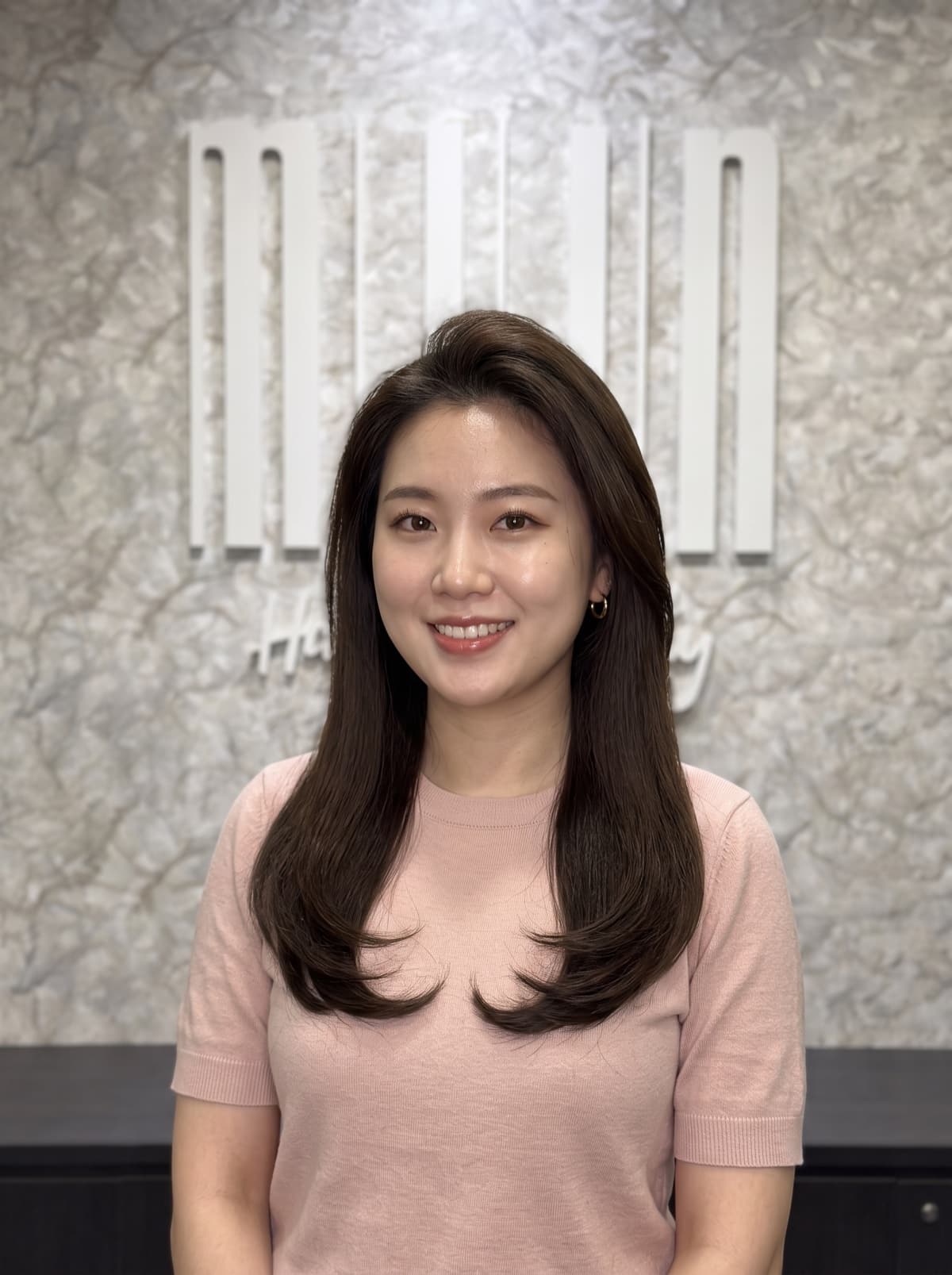
The result is natural straight hair that retains volume at the crown and a soft inward curve at the ends. It looks like it moves and falls freely — not the rigid, one-dimensional finish of traditional rebonding.
The chemicals used are also typically milder than traditional rebonding, reducing the stress on your hair while still making the change permanent.
Volume rebonding vs traditional rebonding
Both treatments permanently straighten your hair and fight frizz. The difference is in the finish.
- Traditional rebonding — pulls hair completely flat during ironing for a pin-straight result. Best if you specifically want sleek, structured straightness with zero wave or body.
- Volume rebonding — curves the iron at the roots and ends to preserve natural lift and movement. Best if you want straight, frizz-free hair that still looks like it moves naturally.
Volume rebonding vs keratin treatment
Both reduce frizz, but they work very differently.
- Volume rebonding — permanently straightens the hair (with body). Lasts until it grows out. More effective for coarse, curly, or very frizzy hair.
- Keratin treatment — coats hair with protein to smooth frizz without restructuring. Keeps your natural texture but makes it more manageable. Lasts 2–4 months. Better for damaged hair or anyone who wants frizz control without straightening.
What to expect during your appointment
A volume rebonding appointment follows a similar structure to traditional rebonding, with the key difference in the ironing technique.
- Consultation (15 min) — your stylist examines your hair’s type, condition, and damage history. Together you discuss how much volume to preserve and whether a soft curve at the ends is desired.
- Preparation — hair is washed and we can apply a scalp protector for sensitive scalps if needed.
- Softening solution (30–45 min) — a milder rebonding cream is applied to soften the hair. The formulation is gentler than traditional rebonding to preserve more natural body.
- Rinse and blow-dry — the solution is rinsed out and hair is blow-dried to prepare for ironing.
- Volume ironing — this is where the technique differs. Instead of pulling the iron flat, your stylist curves the iron inward at the roots (for lift) and bends it gently at the ends (for a soft C-curve). The pressure is lighter and the angle is controlled section by section.
- Neutraliser (20–30 min) — a neutralising solution locks in the new structure — straight through the mid-lengths, with volume at the roots and a curve at the ends.
- Treatment and styling — a conditioning treatment restores moisture (upgrade to Olaplex for extra repair), then your stylist blow-dries and styles the final look.
Who is volume rebonding best for?
Volume rebonding is ideal for anyone who wants straight, frizz-free hair but is put off by the flat, lifeless look of traditional rebonding.
- Wavy or frizzy hair that you want smooth and manageable, but not poker-straight
- Anyone who wants the “natural straight” K-drama look — hair that appears effortlessly smooth with movement
- Medium to thick hair — volume rebonding preserves body that traditional rebonding removes
- Clients who tie their hair frequently — traditional rebonding can look unnatural when tied back because it’s so flat; volume rebonding keeps a more natural silhouette
- Previously rebonded clients who found traditional rebonding too flat and want a more natural finish this time
When to consider an alternative
Volume rebonding isn’t the best choice for every situation. We’ll recommend something different if:
- You want pin-straight, structured hair with no curve — traditional rebonding delivers a sleeker finish.
- You want straight roots with lasting curls at the ends — a magic setting perm combines volume rebonding with a digital perm for permanent curls, not just a temporary curve.
- Your hair is heavily bleached or very damaged — even with milder chemicals, the permanent reshaping is too much stress. A keratin treatment smooths without permanently altering the hair.
- Your hair is very fine and flat — volume rebonding may still remove body you want to keep. Consider keratin for frizz control instead.
- You’ve had back-to-back chemical treatments recently — your hair needs recovery time.
How long does volume rebonding last?
Volume rebonding is permanent on the treated hair. The straightened sections stay smooth until you cut them off. New growth at the roots comes in with your natural texture.
Most clients return for a root touch-up every 4–6 months. Because the grow-out is softer than traditional rebonding — the roots weren’t ironed pin-straight, so the transition between natural regrowth and treated hair is more gradual — many clients find they can go longer between touch-ups.
One important note: the soft curve at the ends is temporary. It’s created by the ironing technique during the appointment, not by a perm. It gradually relaxes over the first few weeks. If you want lasting curls at the ends, a magic setting perm is the better choice — it pairs volume rebonding with a digital perm that gives you permanent curls.
To keep your hair healthy between appointments, we recommend a Miin Express or Miin Signature treatment every 4–6 weeks.
Volume rebonding in Singapore’s climate
Here’s how volume rebonding performs in Singapore’s humidity.
- Straightening and frizz control hold up well — moisture in the air doesn’t cause frizz or reversion, the same reason traditional rebonding is so popular here.
- Root volume is more subtle in humid conditions than in a drier climate — think natural body rather than bouncy volume, but your roots won’t go completely flat.
- Minimal daily styling needed — volume rebonding gives you a frizz-free finish that still looks natural, making it one of the most practical straightening options for Singapore.
Aftercare: keeping your hair healthy and natural
Aftercare for volume rebonding follows the same principles as traditional rebonding, since both are permanent chemical treatments.
- Wait 72 hours before washing your hair — this lets the new shape fully set
- Do not tie, clip, or pin your hair for the first 3 days — any crease can become permanent
- Use a sulphate-free shampoo and a moisture-rich conditioner
- Blow-dry rather than air-dry — air-drying in Singapore’s humidity invites frizz at the roots. Blow downward to maintain smoothness.
- Apply a hair mask weekly to replenish moisture
- Use a wide-tooth comb to detangle — start from the ends and work upward
- Wait at least 2–4 weeks before colouring, ideally 4–6 weeks for best results
- Only touch up the roots at your next appointment — re-processing already treated lengths causes accumulated damage
How long does the appointment take?
A volume rebonding appointment at Miin takes 2.5–3.5 hours depending on your hair’s length, thickness, and natural texture. This is similar to traditional rebonding. Your stylist will give you an accurate estimate during consultation.